
Week 6: Advanced
Scroll down to study the birds by sight and sound, and then take the quiz.
Week 6 Birds
American Robin, Black-headed Grosbeak, Bank Swallow, Barn Swallow, Northern Rough-winged Swallow, Cliff Swallow, Cedar Waxwing


Black-headed grosbeak
Bird Code: BHGR
Identify this bird by…
Hefty songbird with large head
Large, conical bill that’s thick at its base
Short tail gives it a compact look
Tell males and females apart by…
Males: Deep orange breast, collar, and underparts. Black head and upperparts. White under the tail, and white spots on their black tail. Also has white wing bars and wing patches
Females: Black and white crown stripes. Buffy underparts with streaking at the sides. Dark grey upperparts
Look for…
Behavior - Often hidden as they hop about in dense foliage gleaning insects and seeds
Listen for…
Song: Song rises and falls like an AMRO’s, but it’s longer, sweeter, more varied, and less choppy in its phrases
Call: Typical call is a sharp spik uttered frequently to keep contact with mates while foraging. They utter an upslurring wheet upon taking flight.
Resources:
american Robin
Bird Code: AMRO
Identify this bird by…
Fairly large songbird with round body and long legs
Gray-brown on their back with rusty orange underparts
White eyering and yellow bill
In flight, a white patch on the lower belly and under the tail
Tell males and females apart by…
Males: Dark, almost black head. With bolder colors, they have black streaks on the throat and a rusty orange belly
Females: Often paler, lacking a dark head. They often have more white on their belly and throat
Note! - some individuals are not easily distinguishable by sex
Look for …
Behavior - Often seen on lawns searching for earthworms or eating berries and insects
Listen for…
Song: A series of ~10 whistles that rise and fall in pitch and are delivered at a steady rhythm. Described as “cheerily, cheer up, cheer up, cheerily, cheer up”
Call: A mumbled cuck or tuk to communicate with each other or a sharp yeep or peek as an alarm call. They also make a repeated chirr that rises in volume and can sound like a laugh
Resources:


WESTERN TANAGER
Bird Code: WETA
Identify this bird by…
Stocky and heavier-bodied than other warblers
Short-thick based bills
Medium length tails
Tell males and females apart by…
Males: Yellow with black wings and a flaming orange-red head.The wings have two bold wingbars; the upper one yellow and the lower white. The back and tail are black
Females: Red restricted to the front of the face, with subdued yellow-green plumage on the body
Look for…
Forage slowly and methodically along branches and among leaves or needles of trees
Listen for…
Song: Similar to the AMRO’s song, but shorter and raspier. It lasts about 2.5 seconds and consists of a few short, burry up-and-down phrases
Call: 2-3 note chuckling or rattling call
Fun fact!
The amount of red on the heads of adult males is perhaps due to the amount of food consumed containing carotenoids - the pigment that helps produce red feathers
Resources:
BANK SWALLOW
Bird Code: BANS
Identify this bird by…
The smallest of North America’s swallows
Chunky body and large head
Pointed wings and slightly notched tail
Males and females look alike
Tell it apart by…
Warm brown with white underparts
Thick brown band across chest
Brown head with white chin
Underwings are dark
Look for…
Behavior - Most often seen in flight, which is fluttery and fast with periods of brief gliding. Changes course frequently in pursuit of flying insects
Listen for…
Song: A twittery, bubbling chatter wit-wit-dreee-drr-drr-drr
Call: A harsh, guttural tschr tschr
Resources:


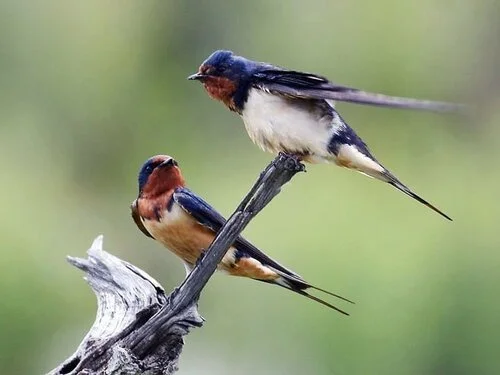


BARN SWALLOW
Bird Code: BARS
Identify this bird by…
When perched, appears cone shaped, with a slightly flattened head and no visible neck
Broad shoulders that taper to long, pointed wings.
Outer feathers give the tail a deep fork
Males and females look alike
Tell it apart by…
Steely blue back, wings, and tail
Rufous to tawny underparts.
Blue crown and face contrast with the cinnamon-colored forehead and throat
White spots under the tail can be difficult to see
Males are more boldly colored than females
Listen for …
Song: a “twitter-warble” song, which consists of along series of continuous warbling sounds followed by several mechanical-sounding whirrs
Call: a cheep call when threatened, and when predators approach too close to a nest site, a churee whistle will send adults diving at the threat
Resources:
NORTHERN ROUGH-WINGED SWALLOW
Bird Code: NRWS
Identify this bird by…
Small, long-bodied bird with a small head and bill
Flies on long and relatively broad, pointed wings
Note their square tail
Males and females look alike
Tell it apart by…
Differs from Bank Swallow with square tail and lacking the brown chest band
Entirely brown above with a dingy throat and chest that fades to white
Juveniles look like adults, but have cinnamon wingbars
Look for…
Behavior - Twists and turns low above water bodies and open areas, taking insects in midair
Listen for…
Song: Its rarely heard song is faint, gurgling, and hoarse sounding
Call: A soft, slightly rising liquid churt
Resources:
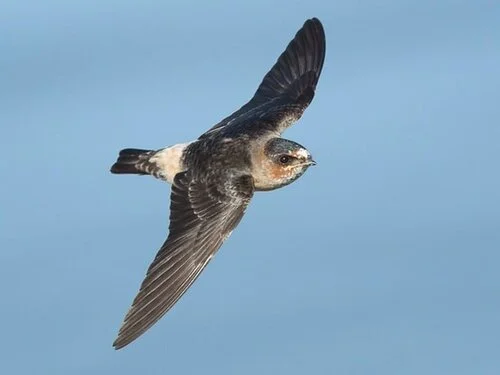


CLIFF SWALLOW
Bird Code: CLSW
Identify this bird by…
Rounded, broad-based wings
Small head and a medium-length, squared tail
Males and females look alike
Tell it apart by…
In poor light, look brownish with dark throats and white underparts
In good light you’ll see their metallic, dark-blue backs and pale, pumpkin-colored rumps.
Rich, brick-red faces and a bright buff-white forehead patch like a headlamp
Some juveniles show whitish throats in summer and fall
Look for…
Behavior - zoom around in intricate aerial patterns to catch insects on the wing
Listen for…
Song: A series of guttural grating sounds and squeaks, usually lasting up to 6 seconds
Call: A soft chur
Resources:


CEDAR WAXWING
Bird Code: CEDW
Identify this bird by…
· Prominent crest with black mask and peachy brown head/chest
· Pale yellow belly and yellow tip to dark tail
· Sometimes has red tips to the secondaries of the wings
· Males and females look the same (not dimorphic)
Look for…
Behavior - Cedar Waxwings are social birds that you’re likely to see in flocks year-round. They sit in fruiting trees swallowing berries whole, or pluck them in mid-air with a brief fluttering hover. They also course over water for insects, flying like tubby, slightly clumsy swallows.
Listen for…
Call: Cedar Waxwings have two common calls: a high-pitched, trilled bzeee and a sighing whistle, about a half-second long, often rising in pitch at the beginning. Cedar Waxwings call often, especially in flight.
Resources:
Feeling ready? Take the quiz!
WEEK 6 WETLAND EXTRAS
Study these birds if you are interested in surveying at Legacy Nature Preserve, the Great Salt Lake Shorelands Preserve, and Utah Lake North Shore.


CLARK’S GREBE
Bird Code: CLGR
Identify this bird by…
A large, slender grebe with a long, graceful neck and long bright yellow to orange bill
Gray-black back and cap, with white underneath
Tell it apart by…
Differentiate from Western Grebe by white completely surrounding the eye in Breeding Adults, and brighter yellow bill. Western Grebe’s have dark surrounding the eye, and their bill is a more dusky yellow.
Listen for…
Call: a high, creaking one-part “kreeeed”
Resources:


WESTERN GREBE
Bird Code: WEGR
Identify this bird by…
Large slender grebe with a graceful neck and long, straight bill
White below with a gray-black on back with a dark cap that extends below the eye.
Tell it apart by…
Differentiate from the Clark’s Grebe by the black on face surrounding the eye (CLGR have white around eye), and dusky yellow-green bill (CLGR have a brighter yellow or orange/yellow bill)
Listen for…
Call: a high, creaking two-part “kreed-kreet”
Resources:


PIED-BILLED GREBE
Bird Code: PBGR
Identify this bird by…
A small, chunky grebe with a blocky head, stout bill, and almost no tail.
Has an overall brownish color. Breeding adults have a distinctive black ring on their pale bill.
Listen for…
Call: a rhythmic series of gulping and cooing notes, or nasal chatter
Resources:


BLUE GROSBEAK
Bird Code: BLGR
Identify this bird by
Stocky songbird
Very large, triangular bill that seems to cover the entire front of its face, from throat to forehead
Both sexes have two wingbars; the upper is chestnut and the lower is grayish to buffy
Tell males and females apart by…
Adult males are deep, rich blue with a tiny black mask in front of the eyes, chestnut wingbars, and a black-and-silver beak
Females/juveniles are primarily rich cinnamon-brown. The color is richer on the head, paler on the underparts; their tails are bluish
Look for…
Behavior - unobtrusive despite their bright colors, although in summer males frequently sing their pleasant, rich, warbling songs
Listen for…
Song: a rich, musical warble continuously for 2 or 3 seconds.
Call: A metallic chink
Resources:


EARED GREBE
Bird Code: EAGR
Identify this bird by…
Small grebe with a relatively short neck, thin, straight bill, and bright red eyes.
Breeding adults are dark with a black head and neck, chestnut sites, and wispy yellow feathers fanning out behind their eyes.
Non-breeding adults have a black cap, white chin patch, dusky gray neck, and black back.
Listen for…
Call: can make a variety of calls, but often does a squeaky, rising “ooEEK”
Resources: